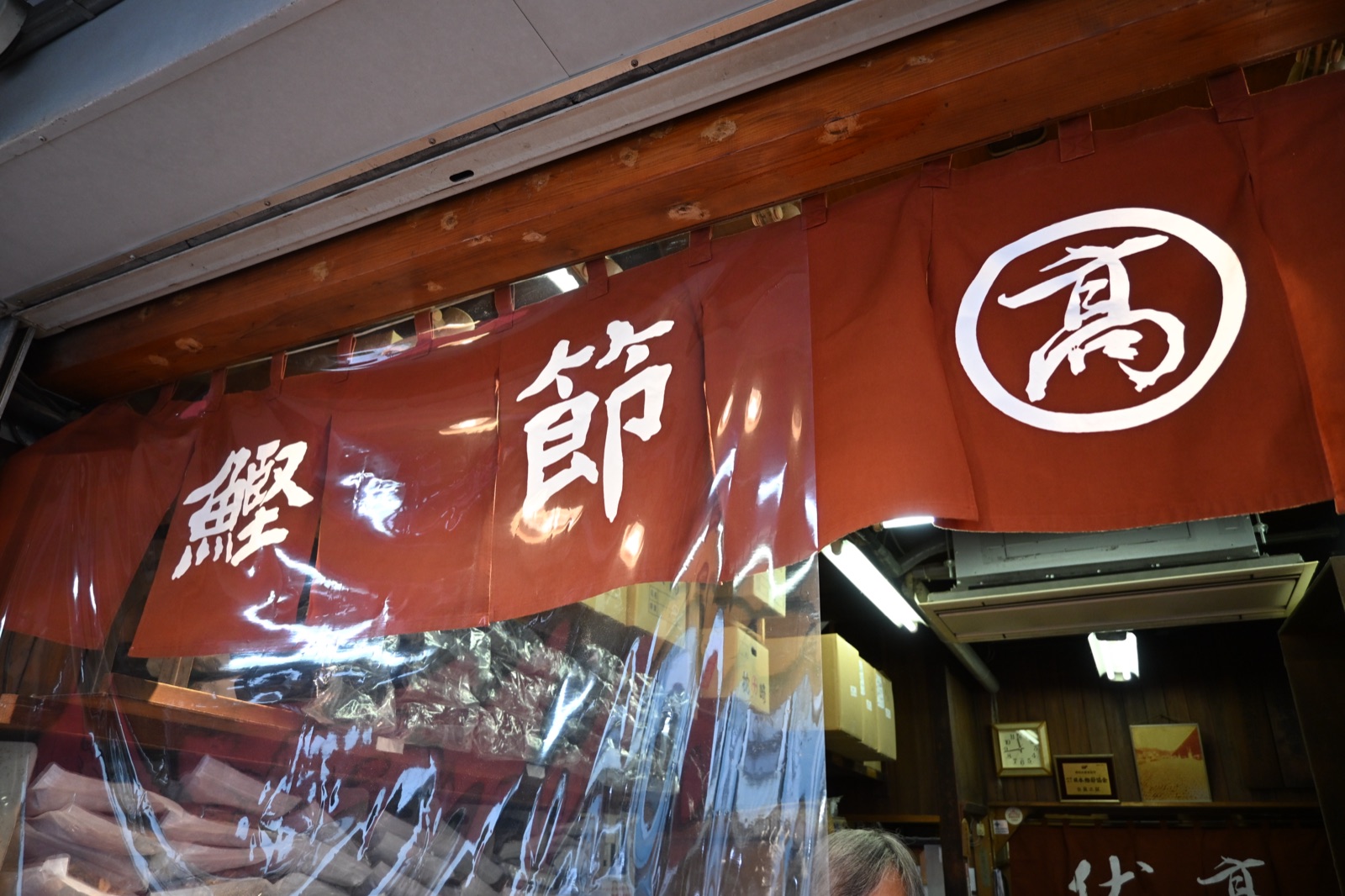
When you pick up a bag of shaved bonito flakes, there is no way to tell which blocks it came from or how they were chosen.
Fushitaka (伏高), in the outer market of Tsukiji, Tokyo, went independent in 1918 (Taisho 7) as a fish wholesaler in Nihonbashi (a trade that buys fish at the market and sells it to restaurants and shops), and later became a katsuobushi (dried, fermented bonito) shop. Today third-generation owner Katsuhiko Nakano runs it, selling wholesale to restaurants and by mail order to general customers.
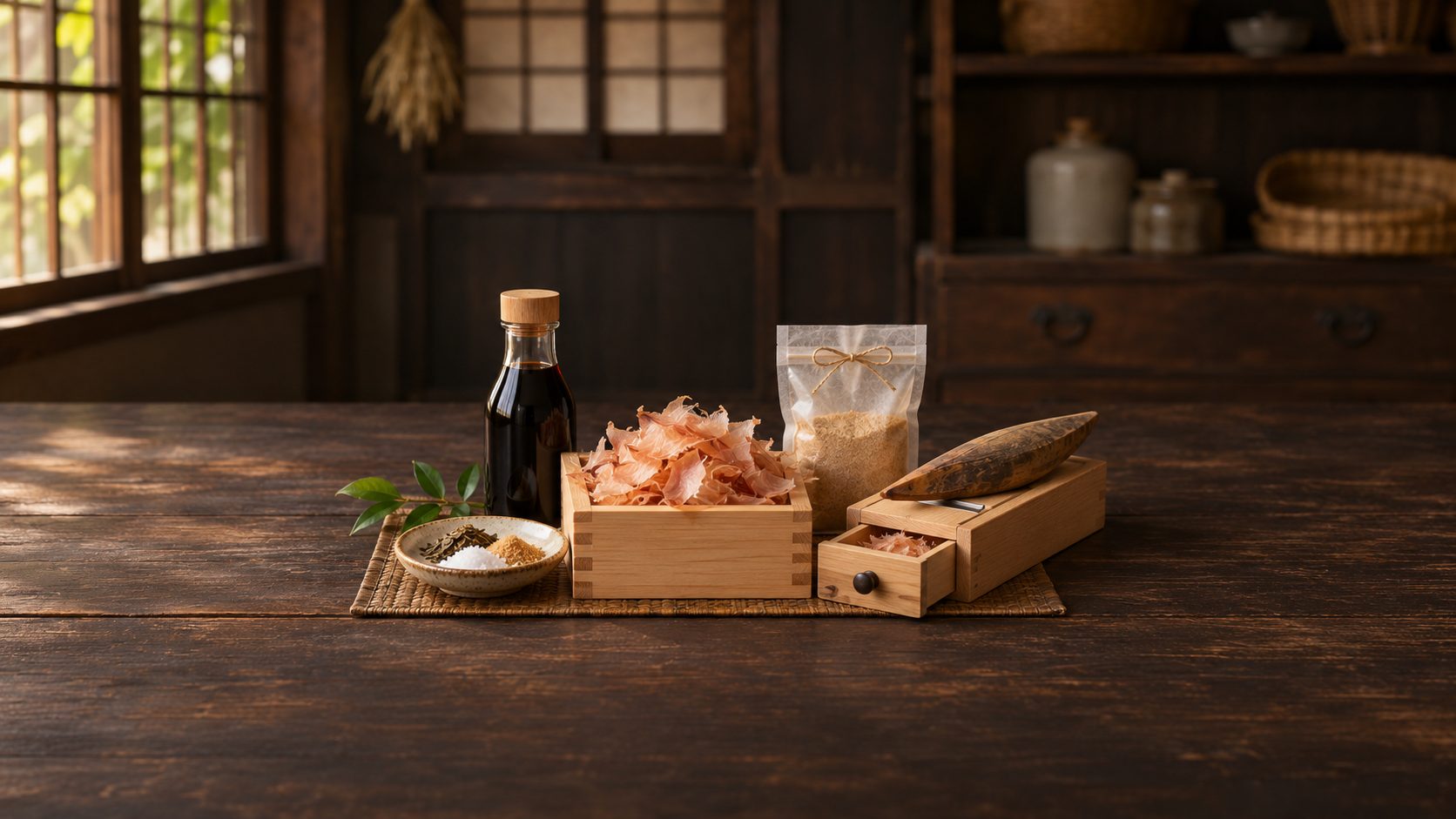
Katsuobushi is a preserved food made by simmering, smoking and drying bonito meat, and the thin shavings of it are called kezuribushi (shaved flakes). To make one kind of shaved flakes, Fushitaka blends blocks of similar raw material made by different makers (the companies that produce katsuobushi). I visited the shop on October 14, 2026, and asked Mr. Nakano why, and about the shop's history.
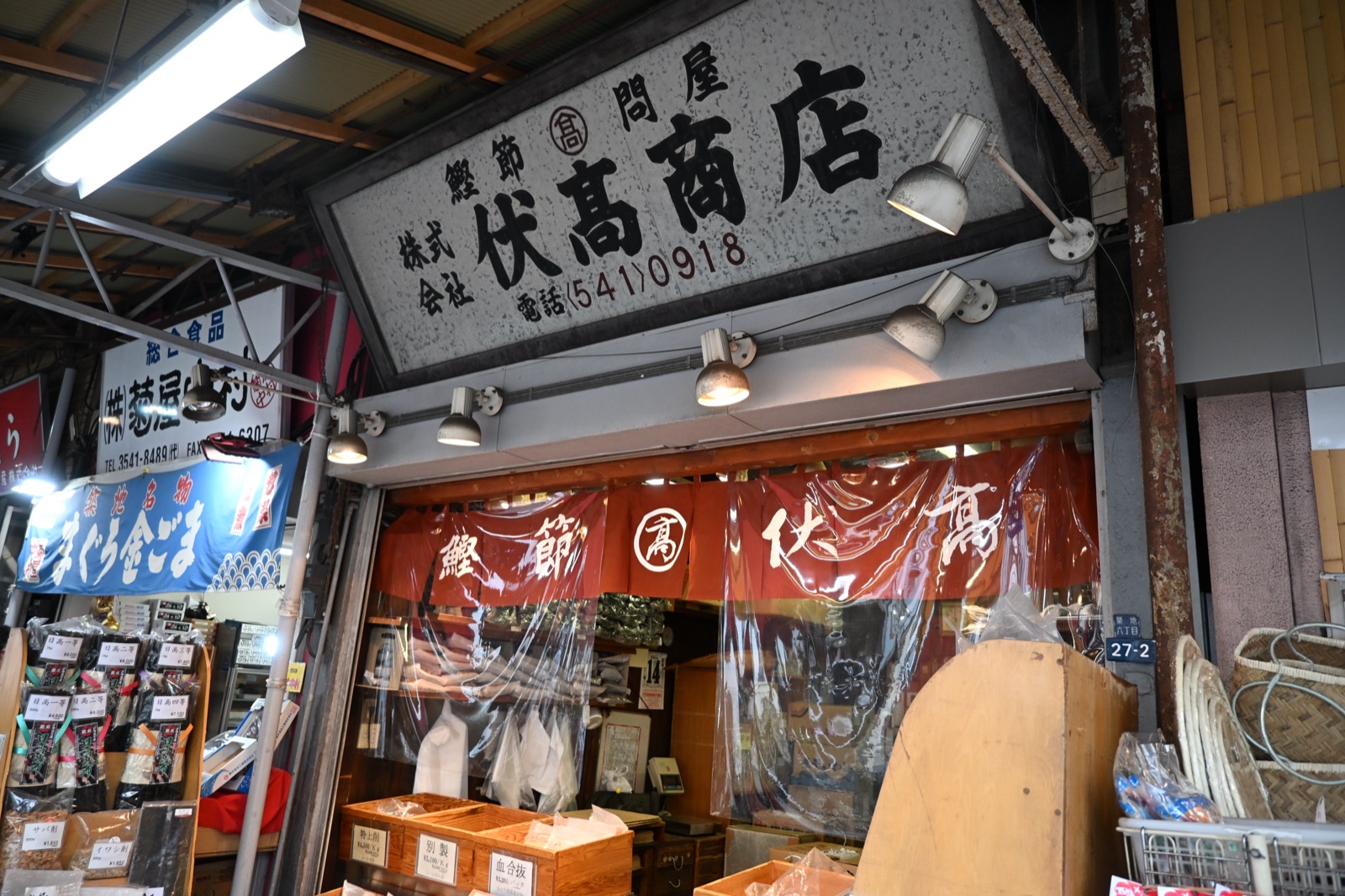
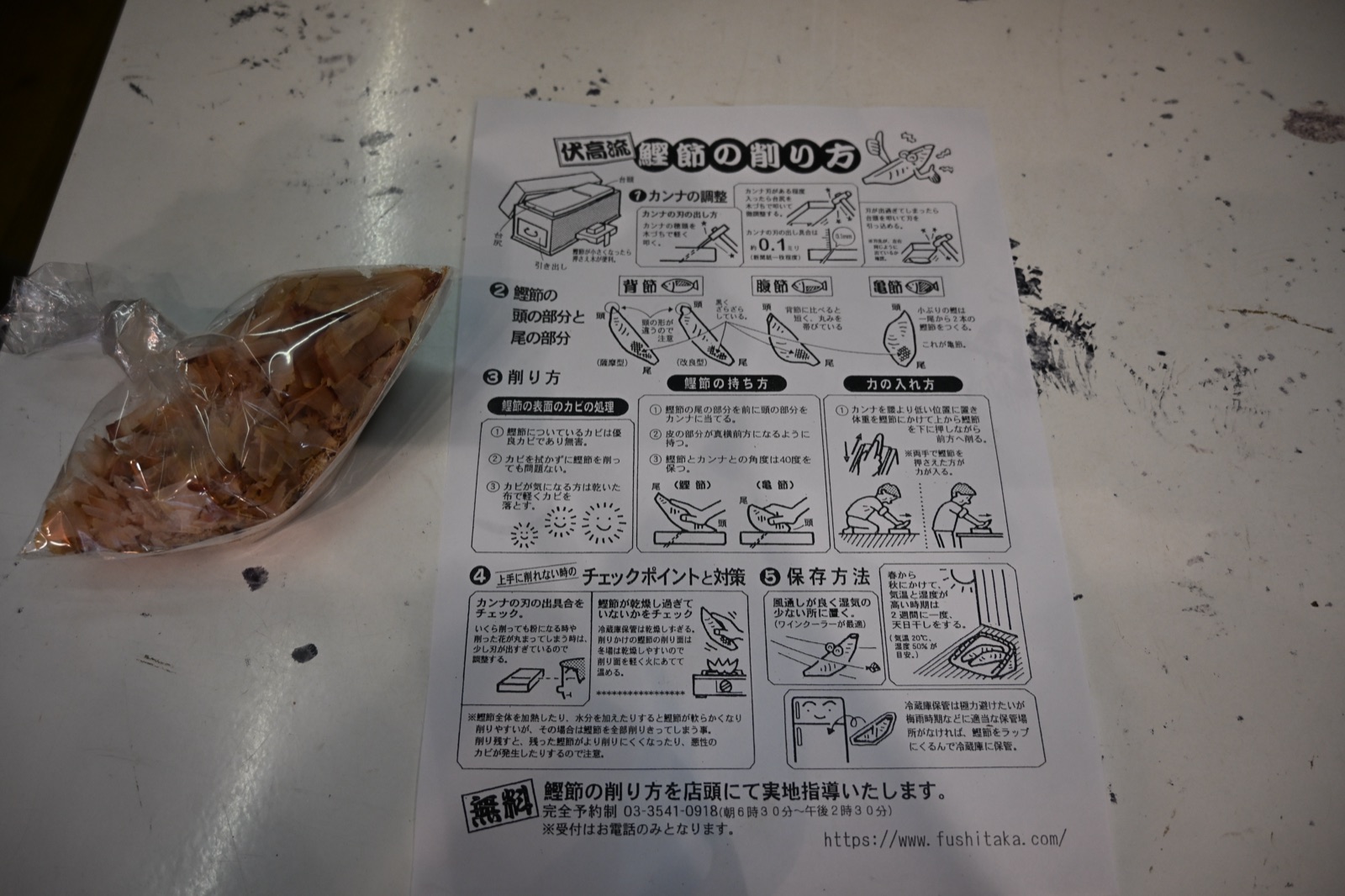
Katsuobushi shaved by hand, and a shop in the Tsukiji outer market
The interview began with a chance to shave a block at the shop entrance. When I shaved one myself, the flakes came out small and crumbled. I found it very hard to get thin, long shavings, because it takes the right pressure and the right angle.
I was allowed to take what I had shaved home, and ate it there. The aroma I smelled on the spot stayed with me. Fushitaka holds a free "katsuobushi shaving class" at the shop, and a step-by-step guide to shaving is kept in the store.
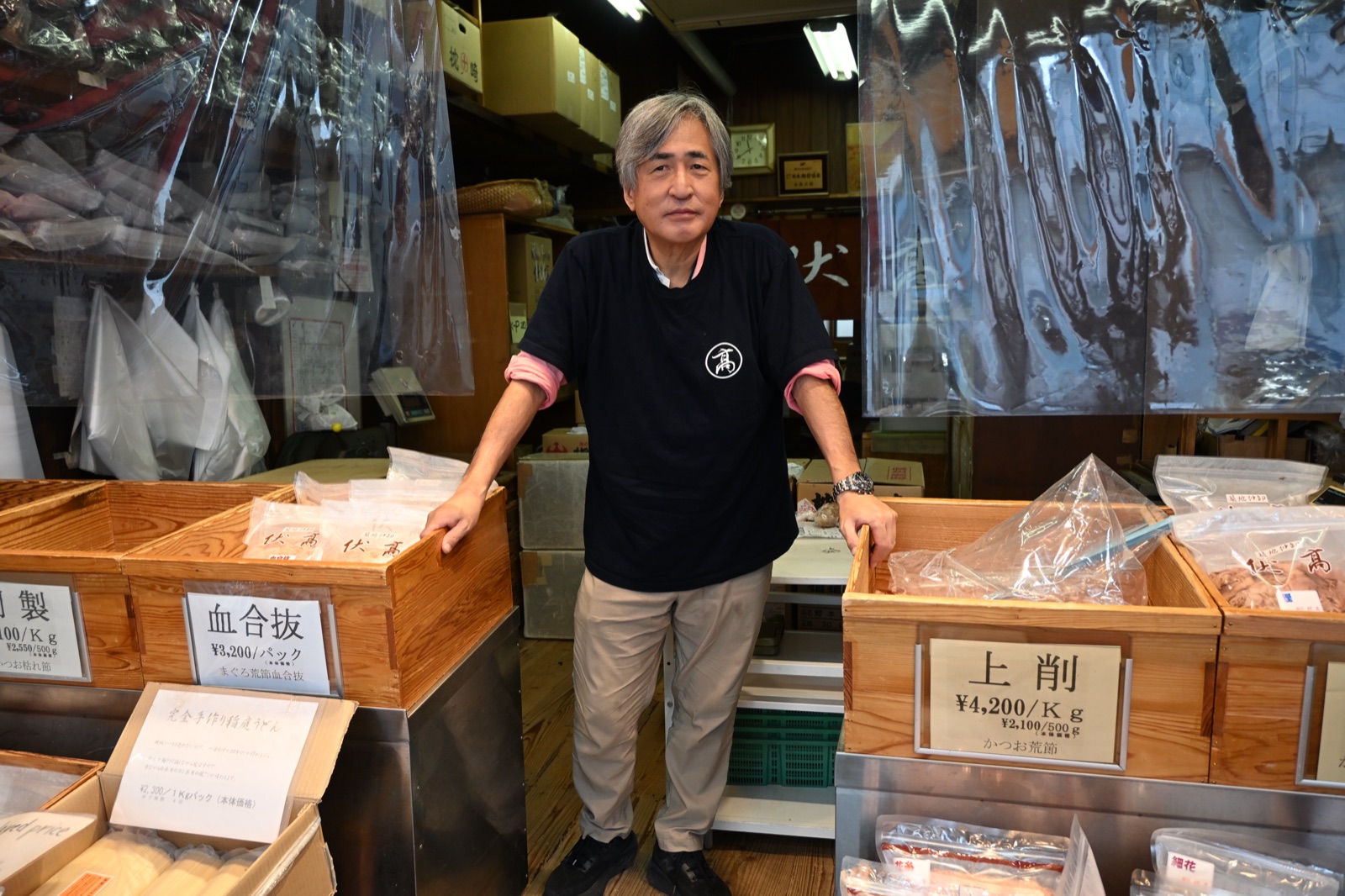
— Do you open early in the morning?
We open a little after 6 a.m. Our business is selling to the restaurants that come to the Tsukiji market to buy. We are not what you would call a retail shop.
The inner market of Tsukiji moved to Toyosu in 2018, but the shops of the outer market stayed in Tsukiji.
— Do tourists buy from you too?
They do. We only sell by weight from 500 grams, so anyone who buys in that amount is welcome. For tourists we also keep a few small 100-gram bags. The shop is small, so the number of products we can stock is limited. For general customers, we ask them to use mail order.
From fish shop to katsuobushi shop, from 1918
— How did a fish wholesaler become a katsuobushi shop?
My grandfather was born in 1895 (Meiji 28). His family had no money, so at 10 he went to work at a fish shop in Nihonbashi. In 1918 (Taisho 7), at 22, he went independent and ran a fish shop in Nihonbashi.
Then the Great Kanto Earthquake of 1923 devastated the Nihonbashi market, and after moving through places like Shibaura, the business finally came to Tsukiji. After that, I don't know exactly when, he decided to give up the fish shop and become a katsuobushi shop. His older brother ran a katsuobushi shop, so I imagine he learned a lot from him.
— What kind of business was a katsuobushi shop in the old days?
When people said katsuobushi, they meant the blocks you shave by hand with a plane. Those were the king of wedding gifts. There were no wedding halls then. Weddings were held at home, and the fish shop delivered the food as catering, with the gifts along with it. My grandfather came from a fish shop, so we had a lot of that business.
— When did restaurants become your main customers?
Wedding halls appeared, fewer people shaved by hand, and in the Showa 40s (1965-1974) sales of shaved flakes overtook the rest. From around then, restaurants have been our main customers. When you sell to restaurants, they start telling you, "Go buy kombu somewhere," "Get niboshi too," so we thought we might as well sell those ourselves, and we began stocking ingredients for sea-based dashi.
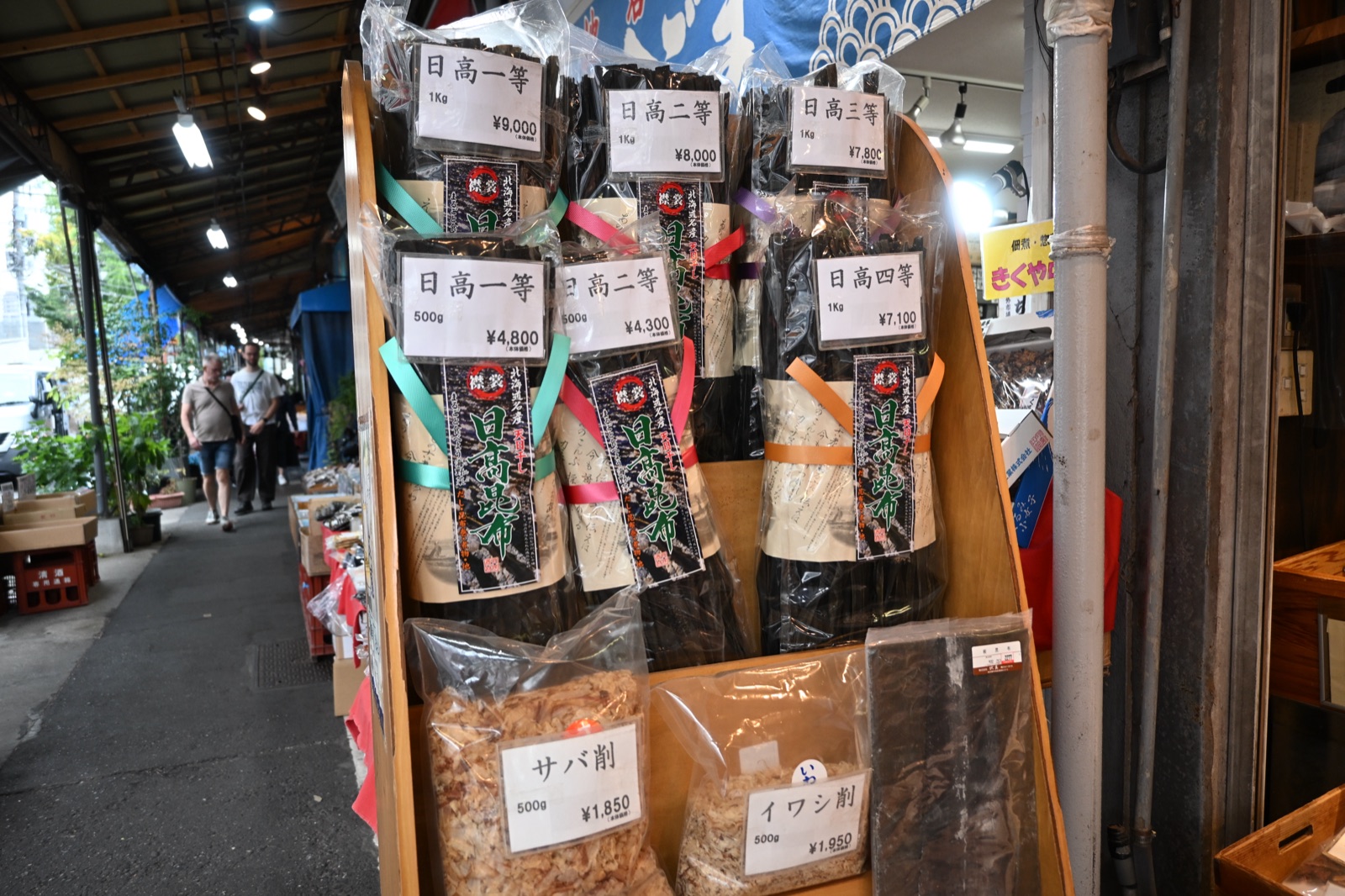
Choosing blocks by their look, and buying from set makers
— When you buy blocks, what do you look at first?
The look. Whether it looks delicious. Plump ones.
— Is a fattier fish better?
With no fat at all there is no flavor, but too much is no good either. A bonito with a lot of fat, like the modori-gatsuo (the fatty bonito that heads south in autumn), doesn't make katsuobushi. It won't set. The bonito that has long been made into katsuobushi is the early summer bonito. It comes on the Kuroshio current, so it doesn't have much fat.
— Do you have set suppliers?
I only buy what certain makers have made. They are in Kagoshima Prefecture. They know very well what I want made, so they never bring me something off the mark, and they keep a certain amount of stock for me.
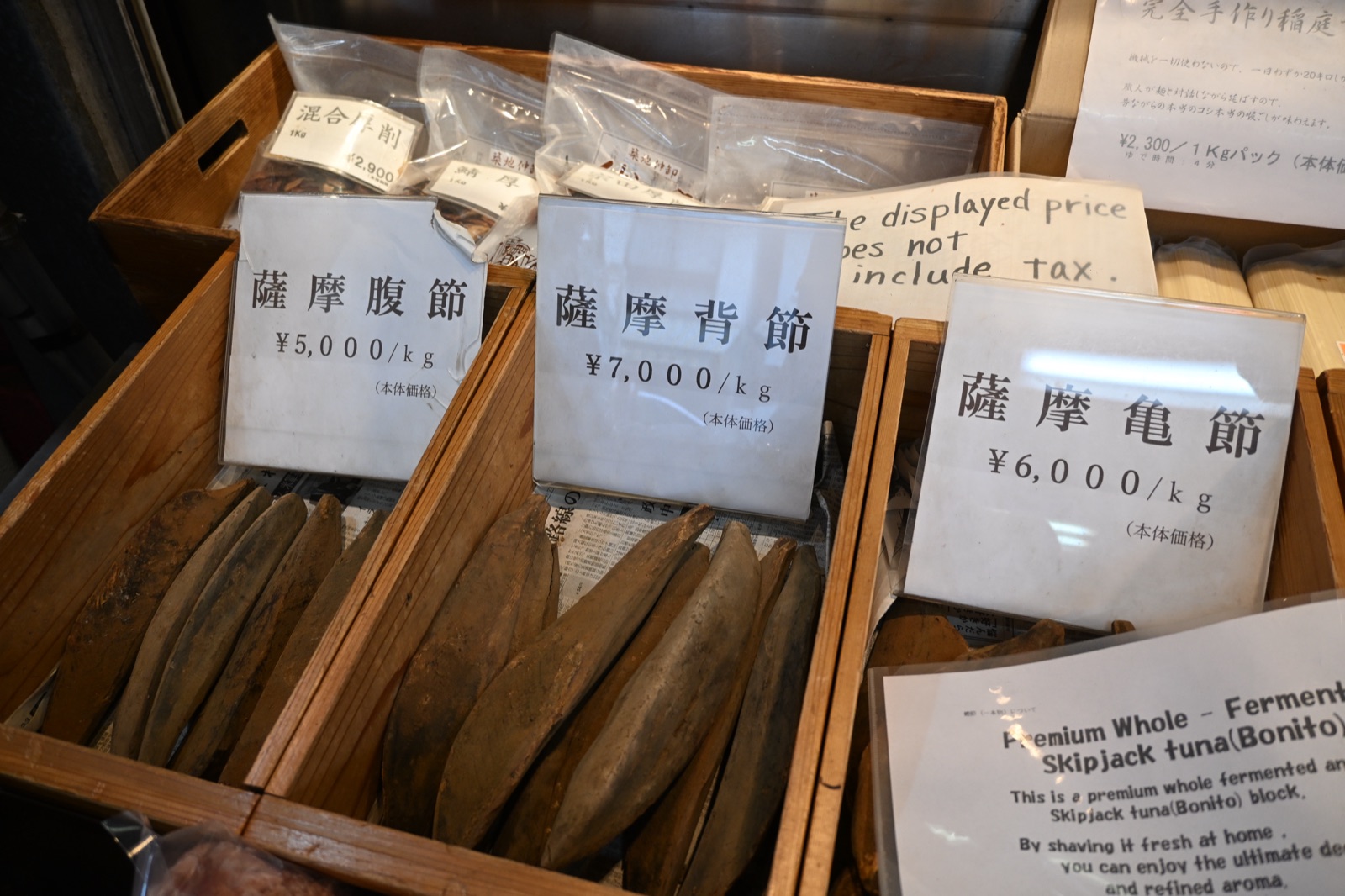
Blending blocks from different makers to even out the flavor of a natural product
— Even from set makers, does the flavor still vary?
It's a natural product, so the flavor varies. It can't be helped, but for restaurants, variation is a problem.
— Do you do anything to keep it from varying?
To make one kind of shaved flakes, I blend two kinds made by different makers from similar raw material. The idea is to reduce the variation by mixing. I don't know what other shops do, but this is what we do.
— Is the blending ratio fixed?
When I mix different kinds of blocks, such as katsuobushi and mackerel blocks, I think about the ratio. If it is all bonito, I sometimes make it 1 to 1.
— Do restaurants really want the flavor never to change?
Above all, a change in flavor is what they don't want. If it changed again and again, they couldn't use it. Making sure that variation in the ingredients doesn't show in the finished dish is also the skill of the chef, though.
— There are other katsuobushi shops too. Why do you think restaurants choose Fushitaka?
I don't know, do I? But I think they believe that if they use our product, they can make something delicious. Shaved flakes are just katsuobushi that has been shaved, so I don't think the flavor differs that much. But our suppliers are different, and the raw material we choose also differs from shop to shop.
— Do you ever tell restaurants how to make dashi?
We sell to professional cooks, so we must not tell them how dashi should be made. Our greatest mission is to sell stable ingredients. We must not talk big. They are professionals.
The price of bonito, set in Bangkok dollars
— What decides the price?
The bonito that becomes katsuobushi today is caught in the South Pacific. It is brought in from around the equator, and it arrives frozen after being caught. In the past the price was more or less set at the auction in Yaizu (a fishing port in Shizuoka Prefecture), but now it is Bangkok.
— Why Bangkok?
In the last 10 or 20 years, more and more bonito has gone into cans. That's tuna cans. The factories that make them are in Bangkok, and Thailand has become a huge buyer. They use more than Japan does. The Bangkok auction is in US dollars (it trades in dollars), so exchange rates play a part too.
— Is the effect of the weak yen large?
The yen got weak, didn't it. That is the hard part. Until about ten-odd years ago, we didn't need to raise the price of katsuobushi, because bonito prices were falling. That reversed, and now it's hard. Over the last ten-odd years we have raised the price of shaved flakes several times. We can't sell at a loss either.
The one who chooses is the one who uses it
— You said you don't tell professional cooks how to make dashi. How do you deal with general customers?
If they ask, I tell them. Everyone's taste is different, so I tell them to find what they like for themselves. I do suggest "there's this way of doing it." I don't intend to sell things because they're healthy. I just want to sell delicious things.
— Why did you start using the phrase "proper ingredients for a rich life"?
I felt that just lining up goods and selling them wasn't enough. In the Showa 40s (1965-1974), granulated "dashi-no-moto" came out and sold very well. It takes effort to make dashi, so fewer people made it, and I thought that was a problem.
— How do you see products like "dashi-no-moto"?
I think there are people who find it delicious. Then they should use it. There are also people who don't find it delicious, and I sell to the people who don't find it delicious. It comes down to "please choose one or the other."
— What kind of people buy through mail order?
It's mail order, so even if I ask their age, they don't tell me. But interestingly, about half are men. Men tend to be more particular. Like people who make soba as a hobby, many of them cook as a hobby. Since it's a hobby, they never say whether the price is high or low.
— Is there anything you would like to pass on from here?
Let's all eat proper food. If you cook with proper ingredients, it is truly delicious, and your heart feels richer too. I don't think every person in Japan would agree with what I say. It would be enough if there were 10,000 or 20,000 people who do.
At the shop you can buy shaved flakes by weight from 500 grams, and if you are far away, you can buy through mail order on the official website.
"Find what you like for yourself." Following Mr. Nakano's words, you can start by choosing one kind of shaved flakes sold by weight and tasting it side by side with the dashi you usually use.
【Fushitaka Co., Ltd. (株式会社伏高)】 Address: 6-27-2 Tsukiji, Chuo City, Tokyo Hours: 6:30 a.m. to 2:30 p.m. Closed: Sundays and Wednesdays (it may also close irregularly depending on purchasing) Official website: https://www.fushitaka.com/
Frequently asked questions
When and how did Fushitaka begin?
In 1918 (Taisho 7), the first-generation owner, Shinkichi Nakano, went independent as a fish wholesaler in Nihonbashi. After the Great Kanto Earthquake the business moved to Tsukiji, and it later became a katsuobushi shop in the outer market. Katsuhiko Nakano is the third-generation owner today.
Where can I buy Fushitaka's katsuobushi and shaved flakes?
At the shop in the outer market of Tsukiji, sold by weight from 500 grams. There are also small 100-gram bags for visitors. For general customers there is mail order through the official website.
What does Fushitaka do to keep the flavor from varying?
It buys from set makers in Kagoshima Prefecture. To make one kind of shaved flakes, it blends two kinds of blocks of similar raw material made by different makers.
What decides the price of katsuobushi?
According to Mr. Nakano, the bonito used for katsuobushi is caught in the South Pacific and arrives frozen. Prices used to be set at the auction in Yaizu, but today the auction in Bangkok is the benchmark, and because it trades in US dollars, exchange rates affect the price.