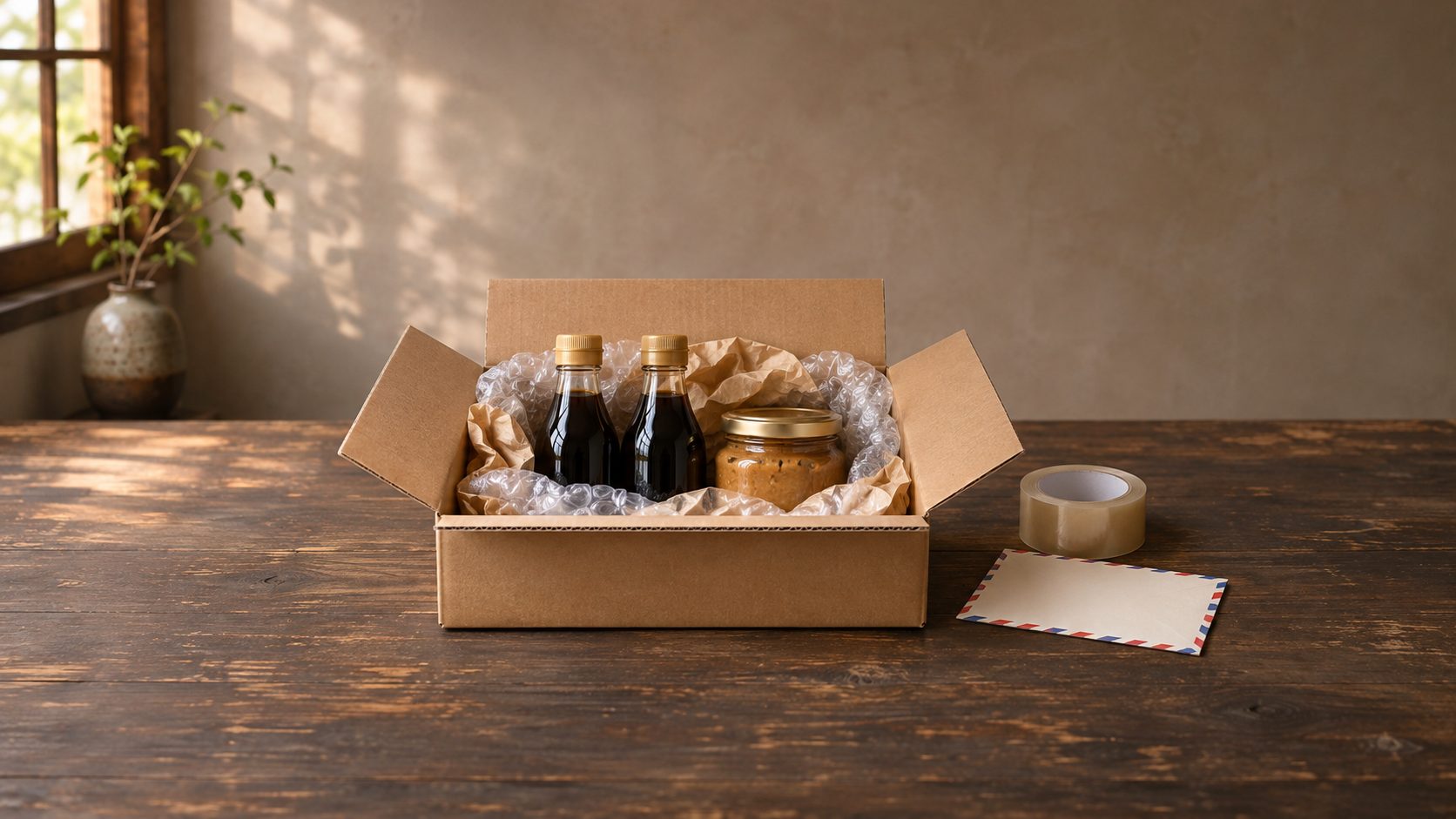
The guides in this series cover what you can carry in your own bag. Mailing is a different route, and the sources for it are thinner. Japan Post publishes the rules for what it will accept. It leaves most food questions to the destination country.
This page was written in November 2026 from Japan Post's published pages. None of them carried a last-updated date, so check the current version before you send anything. Nothing here is legal advice, and the destination's customs makes the final decision.
What Japan Post's pages do not say
Start with the gap. On the pages I read, the list of items that cannot be sent in international mail does not include food, and it does not name seasonings. That is not the same as saying soy sauce can be sent. No page I read says that either.
I also could not find, in those pages, rules on how to pack liquids, which containers are accepted, how much you may send, or what to do about leaks. A bottle of soy sauce breaking inside a parcel contaminates other mail, and Japan Post's general rules ban items whose nature or packaging could contaminate or damage other mail or property (Japan Post, common conditions). That is a rule about the parcel, not about food, but it is the one that applies to a leaking bottle.
The destination decides
Japan Post's English page on country restrictions states the principle and sends you to a country-by-country table:
Some items are prohibited to be imported to certain countries. Please check in advance.
Source: Japan Post, Items prohibited by destination. The page lists liquor, tobacco and meat as items that are commonly prohibited, and it says the per-country check is available in Japanese only. The table itself is at Japan Post, international mail conditions.
The same page gives an example that matters for seasonings: where beef is prohibited, items such as instant cup noodles, curry and instant consommé may not be sent. These are processed foods that contain beef. The point carries over to a soup base or a seasoning made with beef or pork extract, which is also the product that causes trouble for travellers. Our guide to dashi and katsuobushi covers how to read a Japanese label for it.
I did not retrieve the country pages for the destinations in this series, so I cannot tell you what Japan Post's table says for the USA, Canada, the UK, Australia, Singapore, Thailand, Taiwan or Hong Kong.
Alcohol: mirin and sake
Japan Post's Japanese page lists alcoholic drinks over 24 percent as something that cannot be sent anywhere. For alcoholic drinks in general, both the English and Japanese pages add that conditions for mail items apply, and they do not set the conditions out on the same page. The Japanese page also lists alcoholic drinks among examples of flammable liquids, and does not explain how the two statements fit together.
Hon-mirin is an alcoholic drink in Japan at around 14 percent, as our USA guide explains, so it falls into the category where conditions apply and I cannot tell you what they are. Check with Japan Post and with the destination before you send it. Mirin-style seasoning, under one percent alcohol, is a different product.
What the procedure requires
The pages are clear on the procedure, whatever you are sending:
- Electronic customs data must be sent. Japan Post says it cannot accept goods without it (Japan Post, electronic customs data). It covers the sender's and recipient's names and addresses, the description of the contents, the total weight and the mail item number.
- Handwritten labels are no longer accepted. Labels are made through Japan Post's international mail online service.
- An international mail declaration is required at the time of sending.
- Contents are X-rayed after acceptance. Japan Post says that if an item that cannot be sent is found, the mail item may be returned before it goes abroad (Japan Post, nonmailable articles).
- Japan Post does not guarantee clearance. It says a mail item can be returned to the sender or seized at the destination, depending on the destination's law and customs.
For the EU and some other destinations, Japan Post recommends entering a tariff code for the contents, because the destination's customs asks for it. The sender chooses the code, and Japan Post says it cannot check whether it is right. A wrong code can mean delay, a return, or too much duty for the recipient.
What I would do
- Pick the destination's rules first. Read the country guide in this series, and the destination's page on mail or parcels as well as its traveller page. I could not confirm whether the traveller limits apply to parcels
- Look up the country in Japan Post's table and read the entry for food, liquids and alcohol, which is in Japanese
- Leave out anything made with meat extract, and anything liquid you cannot seal well
- Describe the contents plainly and exactly in the customs data, since the data is what the destination's customs reads
- Treat clearance as the recipient's risk too. A parcel can be seized or returned, and the guides above show why each country draws its lines
If you would rather carry than mail, the allowances for each destination are in our comparison of nine destinations, and the light products that are easiest to carry are in our list of seasonings that travel well.
Where to check
- Japan Post: Nonmailable articles in international mail: the list of items that cannot be sent, and the X-ray check
- Japan Post: Items prohibited by destination: the country-by-country principle
- Japan Post: International mail conditions by country: the table, in Japanese
- Japan Post: Electronic customs data and tariff codes: what must be sent and what the codes mean
Japan Post says the table may not reflect the latest conditions, so confirm with the destination's customs before you rely on it.
Frequently asked questions
Can I mail soy sauce or miso from Japan to another country?
Japan Post's pages on items that cannot be sent do not list soy sauce, miso or other seasonings, and they do not say these can be sent either. Whether a given country accepts them is decided by that country's law and customs. Japan Post says items may be seized or returned at the destination, and it does not guarantee clearance.
Where do I check what a country bans in the mail?
Japan Post's international mail conditions table has a page for each country, and the English page on country-specific restrictions says that this check is available in Japanese only. The same English page lists liquor, tobacco and meat as items commonly prohibited, and says items prohibited in certain countries should be checked in advance.
Can I mail mirin or sake from Japan?
Japan Post's Japanese page lists alcoholic drinks over 24 percent as something that cannot be sent anywhere. For alcoholic drinks generally, both the English and Japanese pages say that conditions for mail items apply when sending them, and the pages I read do not set those conditions out. Hon-mirin is an alcoholic drink in Japan, so check the conditions and the destination's rules before you try to send it.
Do I need to fill in a customs form to mail food?
Japan Post requires an international mail declaration, and it requires electronic customs data to be sent for goods. It also says handwritten labels can no longer be used, and that labels are made through its international mail online service. I did not find instructions on how to describe food contents in the pages I read.
Are the traveller limits in your country guides the same for parcels?
I do not know, and the pages I read do not say. The limits in our guides are for food you carry in your own luggage. Parcels can follow different rules and different customs treatment, so check the destination's page for mail and parcels as well as its traveller page.