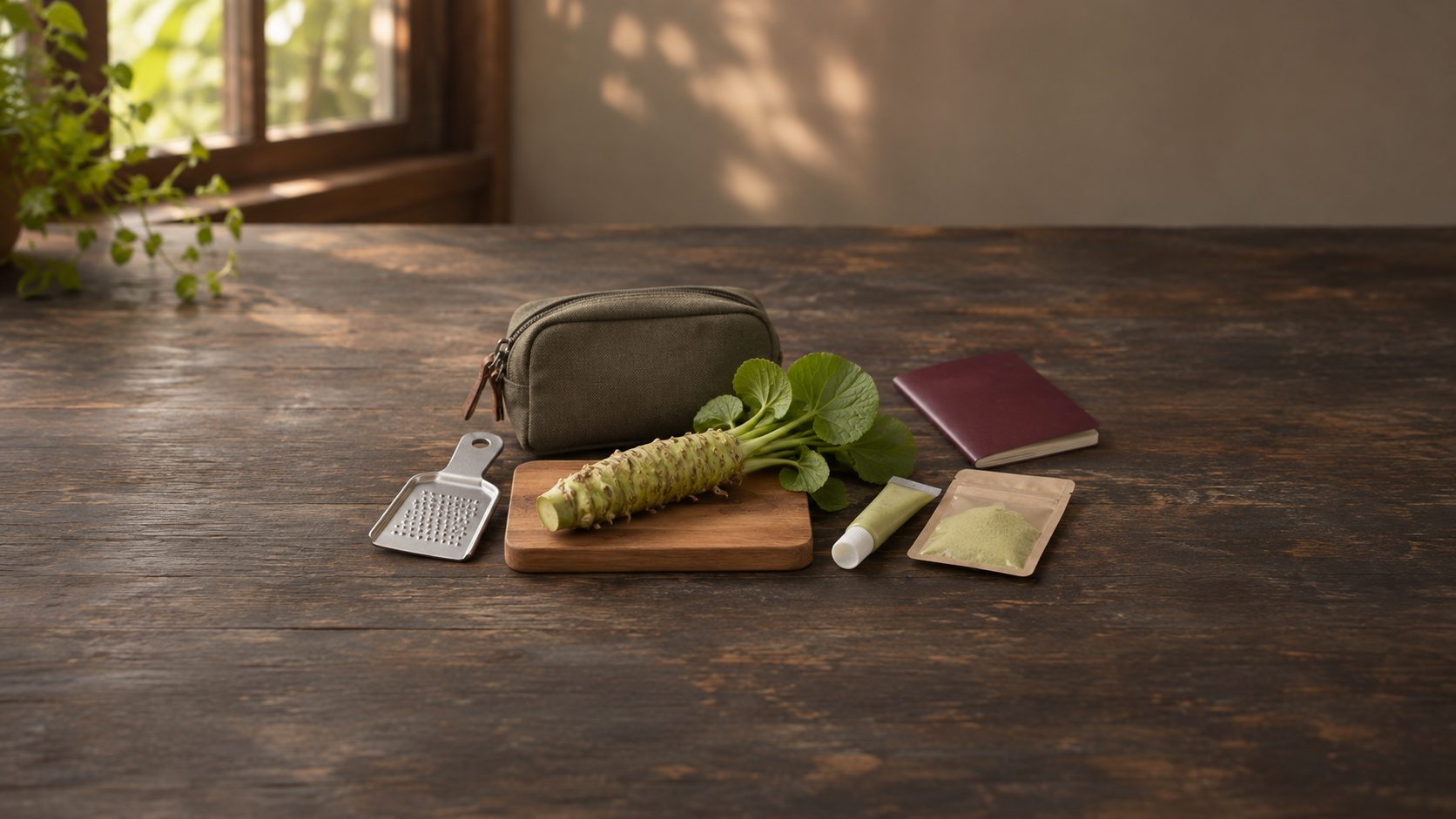
People ask this more than most seasoning questions, and the honest answer has two halves. The wasabi that comes in a tube or a tin is an ordinary condiment. The wasabi that is a green root is a plant.
This page was written in November 2026 and links to the official sources throughout. Rules change, so check the source before you fly. Nothing here is legal advice, and the officer at the border makes the final decision. One thing to say first: none of the official pages I checked names wasabi. Where I place it, I place it by category, and I mark that as my reading.
Four forms of wasabi, and where each one sits
| What you bought | What it is to customs | My reading |
|---|---|---|
| Paste in a tube | Processed condiment | Generally fine, declare it |
| Dry powder in a tin or sachet | Processed flavouring or spice | Generally fine, declare it |
| Wasabi-flavoured furikake or snacks | Processed food | Generally fine, but check for meat or egg in the blend |
| Fresh root (the rhizome) | Fresh plant produce | Leave it in Japan |
The split follows what each country's rules actually regulate. Condiments and packaged flavourings sit on the permitted side almost everywhere. Fresh fruit and vegetables are the category that attracts permits, certificates and inspection.
The fresh root
Wasabi root is sold wrapped in a shop's chilled section, and it is the part of the plant people picture when they think of the real thing. It is also the form where the rules turn strict.
The UK's GOV.UK page is the clearest statement of the principle:
You cannot bring in most fruit or vegetables unless you have a 'phytosanitary' (plant health) certificate for them.
Source: GOV.UK, fruit, vegetables, nuts and seeds. Wasabi is not named, and the page lists a few exemptions, so this is a reading of the rule, not a ruling on wasabi.
The US customs guidance for visitors takes the same direction, requiring fresh fruit and vegetables to be declared and saying they may be inspected or refused (CBP, Bringing agricultural products to the United States). Canada's personal-use table gives fresh vegetables a row of their own, and wasabi root is not named in it (CFIA, personal use exemption). If you want to test that row, the CFIA's import database, AIRS, is where to ask.
The practical answer is the same as for fresh yuzu. It does not travel well either, since wasabi root loses its scent within days of being grated. The fresher the root, the less sense it makes to carry it across a border for a week.
Tube paste and powder
Tube wasabi is a paste, so it lands in the condiments group with soy sauce and miso. The guides in this series show how each country handles that group: the USA, Canada, the UK, the EU, Australia, Singapore, Taiwan and Hong Kong. In each, a sealed, labelled, plant-based condiment is the easy case.
Powder is drier and lighter still. The Japanese aviation security list says dried spices such as chilli, pepper and curry powder are not covered by the liquid restriction, and it does not name wasabi powder, so I read a tin of it as falling under the same exception. Read the ingredients of a flavoured powder or furikake, because a few blends contain egg, meat or fish, and those are the parts a customs officer cares about.
On the plane
A normal tube of 43g to 45g is well under the 100ml limit, so it goes in the clear 1L bag with your other cabin liquids and pastes. Japan's aviation security list covers condiments in tubes and names soy sauce and miso, and it does not name wasabi, so I am applying its test: an item that cannot hold its shape without its container is treated as a liquid or paste. Full details and the source are in our guide to carrying miso and soy sauce on a flight out of Japan.
Which tube is worth carrying
A tube is worth the suitcase space only if it contains wasabi. Many supermarket tubes are mainly Western horseradish with mustard and colouring, and the heat they give is horseradish heat. The label wording is the clue: hon-wasabi iri (本わさび入り, contains hon-wasabi) and hon-wasabi shiyo (本わさび使用, uses hon-wasabi) are not the same claim, and the ingredient order shows how much is in there. Our guide to how to pick a tube that still has scent goes through it.
One example from the catalogue is the Tamaruya Honten tube from Shizuoka, a long-established wasabizuke maker that sells a line made with hon-wasabi grown in the prefecture. Shizuoka is the district most associated with wasabi cultivation.
If you live in the US
Wasabi in a tube is among the easier Japanese products to find in the United States. This is the listing I could confirm on Amazon.com in November 2026, and it links straight to the product page:
- S&B Premium Wasabi Paste in Tube, 1.52 oz: the listing says it contains real wasabi. Other S&B tubes on Amazon are horseradish-based with colouring, so check the ingredients of the one you choose
Stock and price change often, and I have not listed a price. The link carries no tracking tag, and we receive nothing if you buy.
A short checklist
- Tube and powder are processed condiments and generally fine
- Fresh root stays in Japan. It is produce, and the UK, the US and Canada all treat fresh produce under separate rules
- Check flavoured blends for egg, meat or fish
- Declare it wherever your country asks for all food to be declared
- Read the label for hon-wasabi before you spend suitcase space on it
Where to check before you fly
- GOV.UK: Fruit, vegetables, nuts and seeds: the plant health certificate rule
- CBP: Bringing agricultural products to the United States: declaring fruit and vegetables
- CFIA: Personal use exemption and AIRS: Canada's table and its import database
- MLIT: List and Description of LAGs Restriction: the Japanese cabin-bag list
If you are carrying fresh root for a specific reason, ask the destination's border agency about that exact item before you pack it.
Frequently asked questions
Can I bring wasabi back from Japan?
Processed wasabi, meaning paste in a tube or dry powder, is generally fine, because customs rules treat it as a condiment or flavouring. Fresh wasabi root is a different matter, because it is plant produce, and fresh produce is the category most countries restrict. None of the official pages I checked names wasabi, so this follows the category rather than a quoted rule.
Can I bring fresh wasabi root into the USA, UK or Canada?
Treat it as fresh produce and plan to leave it behind. The UK says you cannot bring in most fruit or vegetables without a phytosanitary certificate. The US customs guidance says fresh fruit and vegetables must be declared and may be inspected or refused. Canada's personal-use table has a row for fresh vegetables but does not name wasabi root, so check its import database (AIRS) before you try.
Is wasabi paste allowed in carry-on luggage?
A standard tube of about 43g to 45g is well under 100ml, so it can go in the clear 1L bag in your cabin bag. Japan's aviation security list covers condiments in tubes and names soy sauce and miso, but it does not name wasabi, so I am applying its general test for pastes. A large tube or tub over 100ml goes in checked baggage.
Is tube wasabi real wasabi?
Often not. A good many supermarket tubes are mainly Western horseradish with mustard and colouring, with only a little wasabi or none. The label wording matters, because hon-wasabi iri (本わさび入り) and hon-wasabi shiyo (本わさび使用) are not the same claim.
Do I need to declare wasabi paste at customs?
Declare it if your country asks for all food to be declared, which the US, Canada, Australia and the UK guidance all do in some form. Declaring a sealed tube costs nothing. Not declaring is where the penalty sits.